Project Overview
Educational inequality begins long before a student sits down for a standardized test; it begins in the home. SNAP provides food assistance to help low-income households pay for groceries, but its benefits are not limited to nutrition. By increasing food-purchasing resources, SNAP can expand the household budget and help families absorb expenses across multiple domains. For children, this kind of material stability translates to basic-needs security and reduced household stress, which may affect the conditions that support development and learning.
SNAP’s stabilizing benefits can only be realized if eligible households successfully access and maintain benefits over time. This thesis focuses on certification length because it determines how often households must re-prove eligibility in order to continue receiving benefits. Shorter certification periods require households to recertify more frequently, increasing exposure to paperwork, interviews, deadlines, and the risk of procedural failure.
This thesis asks whether longer SNAP certification periods are associated with changes in the economic disadvantage achievement gap. To answer that question, I use a state-year panel combining educational outcomes from Stanford Education Data Archive, SNAP participation estimates from USDA’s Reaching Those in Need reports, and average certification length from the USDA SNAP Policy Database. I then apply a difference-in-differences design with state and year fixed effects to compare changes in treated states after certification length increased to changes in control states over the same period.
-0.045
Estimated standard-deviation reduction in the economic disadvantage achievement gap after treated states increased SNAP certification length.
-0.038
Similar estimated gap reduction when treated states are compared only with low-certification control states.
419
State-year observations in the main achievement-gap model, using state and year fixed effects with state-clustered standard errors.
Literature Review Highlights
The literature review builds the mechanism tested in this project: SNAP reduces poverty depth and material hardship, administrative burden can reduce program access, certification length shapes exposure to recertification burden, and household resource stability is linked to academic performance.
SNAP Stabilizes the Household
SNAP reduces poverty depth and material hardship, especially for children, by increasing food-purchasing resources and helping households absorb expenses across multiple domains (Tiehen, Jolliffe, & Gundersen, 2012; Dasgupta & Plum, 2023).
Burden Creates Stability Inequity
Administrative burden includes learning, compliance, and psychological costs that can prevent eligible households from accessing or maintaining benefits. These costs often fall hardest on individuals with fewer resources, exacerbating inequality (Herd & Moynihan, 2025; Murphy, 2023).
Recertification Interrupts Stability
Shorter certification periods expose households more often to paperwork, interviews, deadlines, and the risk of procedural failure. SNAP exits cluster around recertification months and are often linked to missed deadlines, while easing procedural barriers can improve access (Gray, 2018; Giannella et al., 2024).
Household Stability Reaches School
SNAP benefit timing, food availability, and household stress are linked to academic performance. Administrative burden in child-serving programs can also affect supports related to children’s health, development, and school readiness (Gassman-Pines & Bellows, 2015, 2018; Heinrich et al., 2022).
Policy Variation
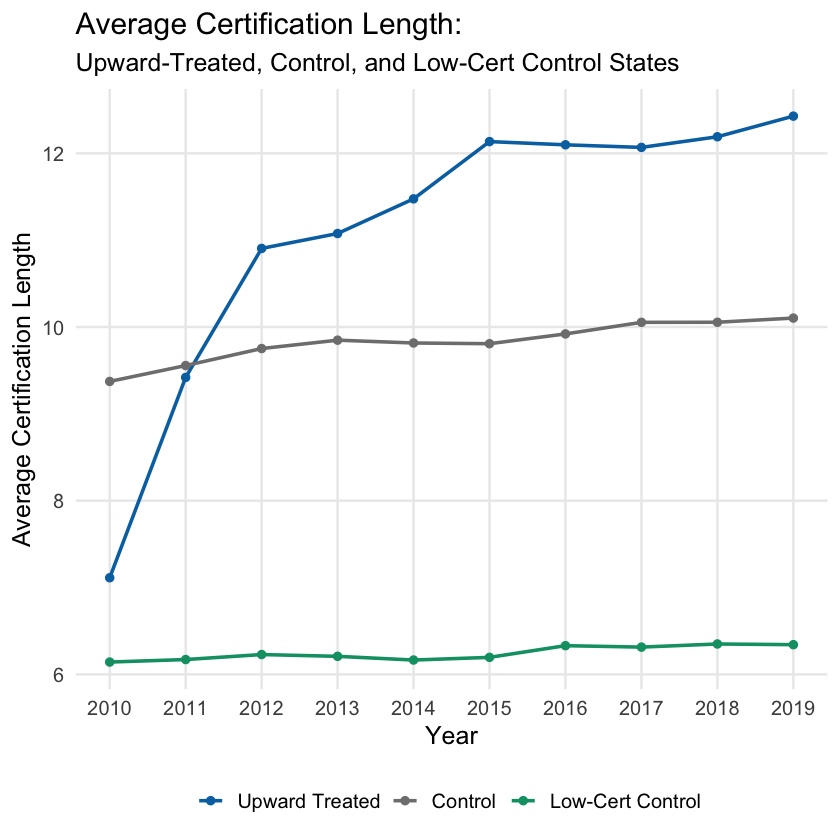
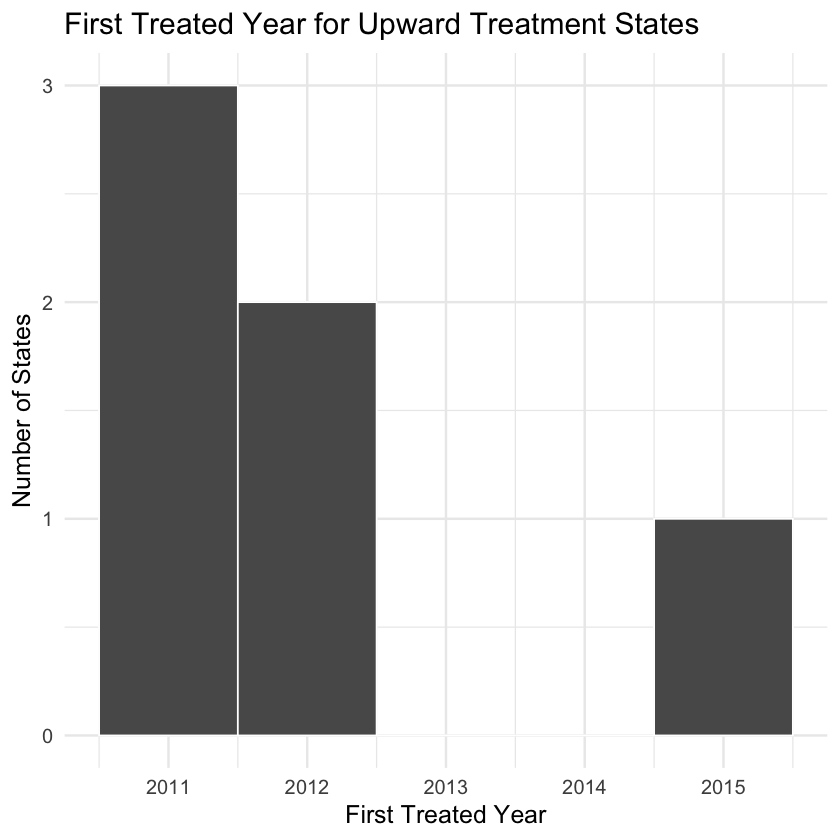
Treatment is defined as a meaningful upward increase in average SNAP certification length compared to the 2010 baseline. Six states are treated during the study period, with first treatment years in 2011, 2012, and 2015. Control states are those without a sustained upward or downward certification-length change, and low-certification controls are the subset that remained near a low average certification length throughout the study.
Certification Length by Treatment Group
First Treated Year
Model Specification
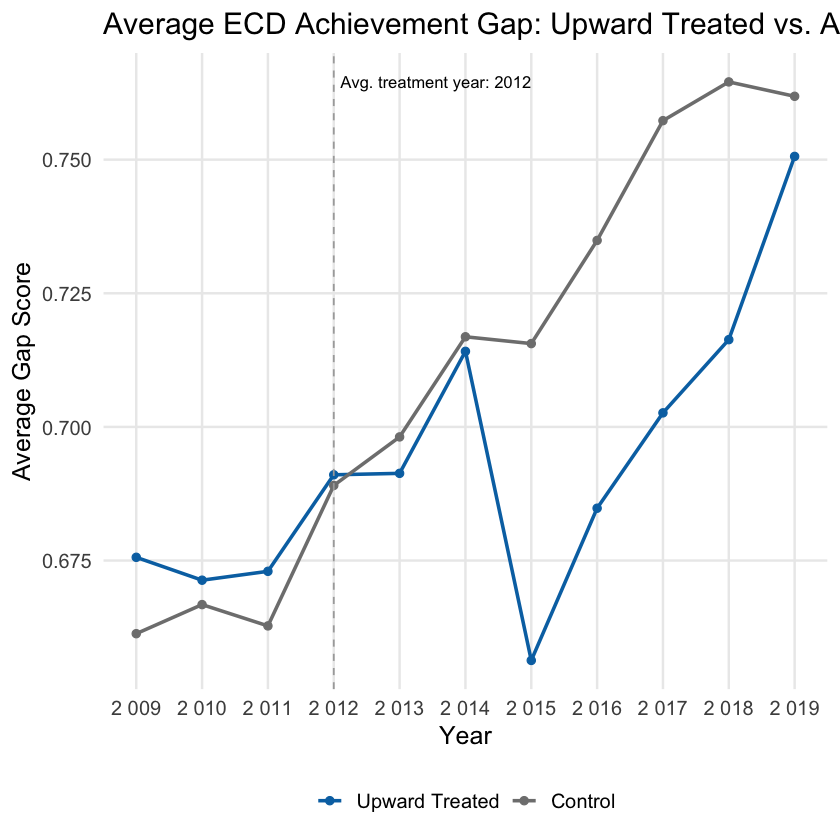
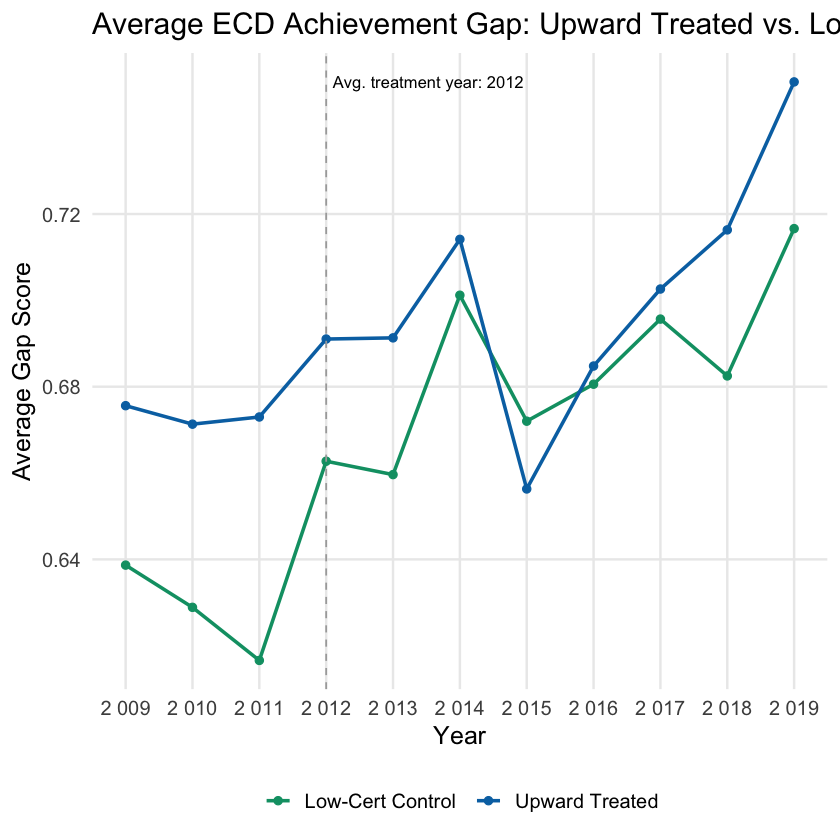
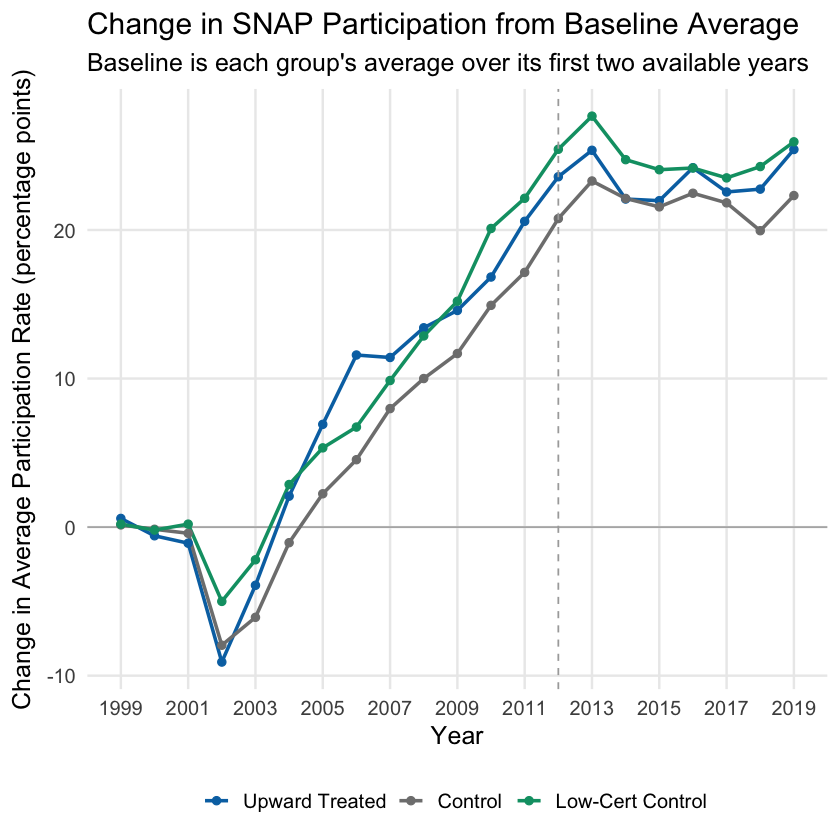
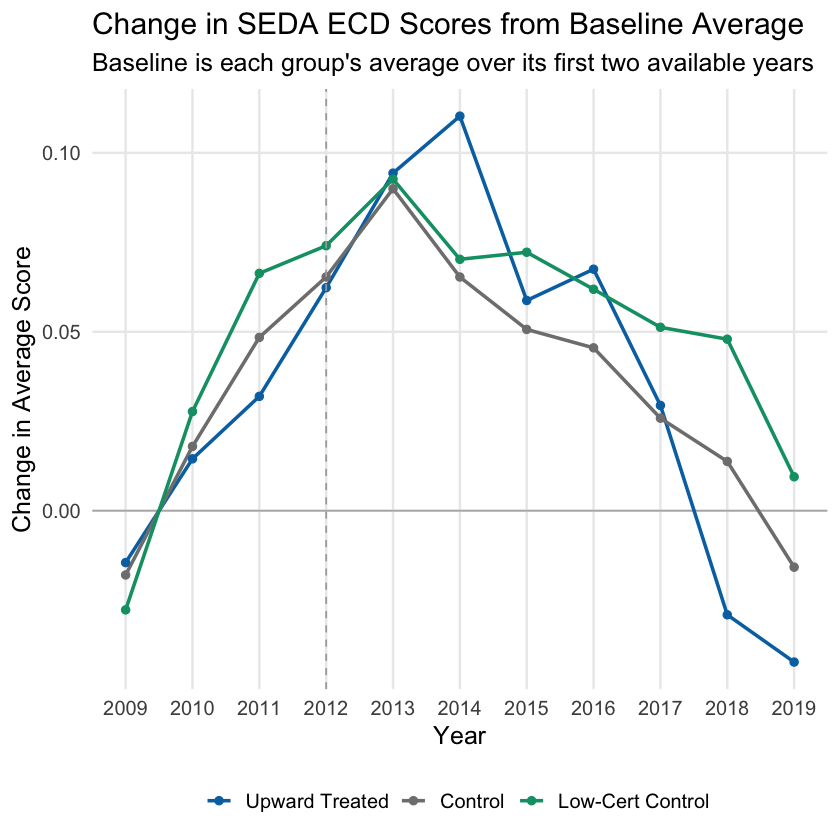
The core difference-in-differences model estimates whether the economic disadvantage achievement gap changed after certification length increased. State fixed effects account for persistent differences across states, year fixed effects account for national shocks or common trends, and state-clustered standard errors account for repeated observations within the same state over time. Pre-treatment trends are examined to assess whether the control groups are plausible counterfactuals for the treated states.
In this specification, Gapst is the state-year economic disadvantage achievement gap. The coefficient β1 estimates how much the gap changed in treated states after certification length increased, relative to the change in control states over the same period. A negative coefficient means the economic disadvantage gap narrowed after the policy change; a positive coefficient would mean the gap widened.
Main Finding
Longer certification periods are associated with a statistically significant reduction in the economic disadvantage achievement gap. The main model estimates a 0.045 standard deviation reduction, while the low-certification control model estimates a 0.038 standard deviation reduction. The similarity across models strengthens the evidence that upward certification-length treatment is associated with a narrower economic disadvantage gap.
| Model | Estimate | Std. Error | p-value | Observations | Adjusted R2 |
|---|---|---|---|---|---|
| Main DiD | -0.045 | (0.018) | 0.017** | 419 | 0.84 |
| Low-certification controls | -0.038 | (0.017) | 0.040** | 182 | 0.89 |
* p < 0.10, ** p < 0.05, *** p < 0.01.
Achievement Gap: All Controls
Achievement Gap: Low-Certification Controls
Participation and SEDA ECD Mechanism Check
The participation and SEDA ECD analyses are organized by the role each regression plays in the empirical design: testing the proposed mechanism and examining whether outcomes for economically disadvantaged students moved in the expected direction. Participation rates provide a potential test of the mechanism by which certification length policy impacts educational inequality through program access and stability.
The mechanism-testing results are directionally consistent with the administrative-burden mechanism, though less conclusive than the achievement-gap results. In the fixed-effects participation model, a six-month increase in certification length predicts a 4.374 percentage point increase in SNAP participation, holding all else constant. The treatment-based participation DiD estimate is positive but not statistically significant, and the SEDA ECD achievement-score estimate is also positive but not statistically significant. These results should be interpreted as mechanism evidence rather than a direct measure of household-level program stability; they suggest that certification length may shape statewide SNAP access, while the strongest evidence appears in the achievement-gap models.
| Participation Model | Estimate | Std. Error | p-value | Observations | Adjusted R2 |
|---|---|---|---|---|---|
| Certification length | 0.729 | (0.371) | 0.055* | 510 | 0.770 |
| Post upward treatment | 2.195 | (2.838) | 0.443 | 510 | 0.765 |
* p < 0.10, ** p < 0.05, *** p < 0.01.
SNAP Participation Pre-Trends
SEDA ECD Achievement Score Pre-Trends
Interpretation
Finding Significance
The strongest evidence appears in the achievement-gap models, where upward certification-length treatment is significantly associated with a narrower economic disadvantage gap. These findings suggest that SNAP administrative design may have downstream impacts on educational inequality for economically disadvantaged children. The mechanism evidence is also consistent with this interpretation: longer certification periods may reduce household exposure to recertification events, reduce program churn, and improve SNAP stability.
Because treatment is not randomized and SEDA does not identify SNAP-recipient students directly, the results should be interpreted as evidence of an association between SNAP administrative policy and educational inequality, not definitive proof of causation.
Future Research
Future research should draw on household-level administrative data to track households through SNAP entries, exits, and recertification deadlines. A national or multi-state administrative database would make it possible to compare how different state policy choices affect program churn and benefit access. Overall, this study's findings suggest that further research on administrative burden in SNAP may be warranted, with potential implications for household stability and educational equity.